
 GIVE
GIVE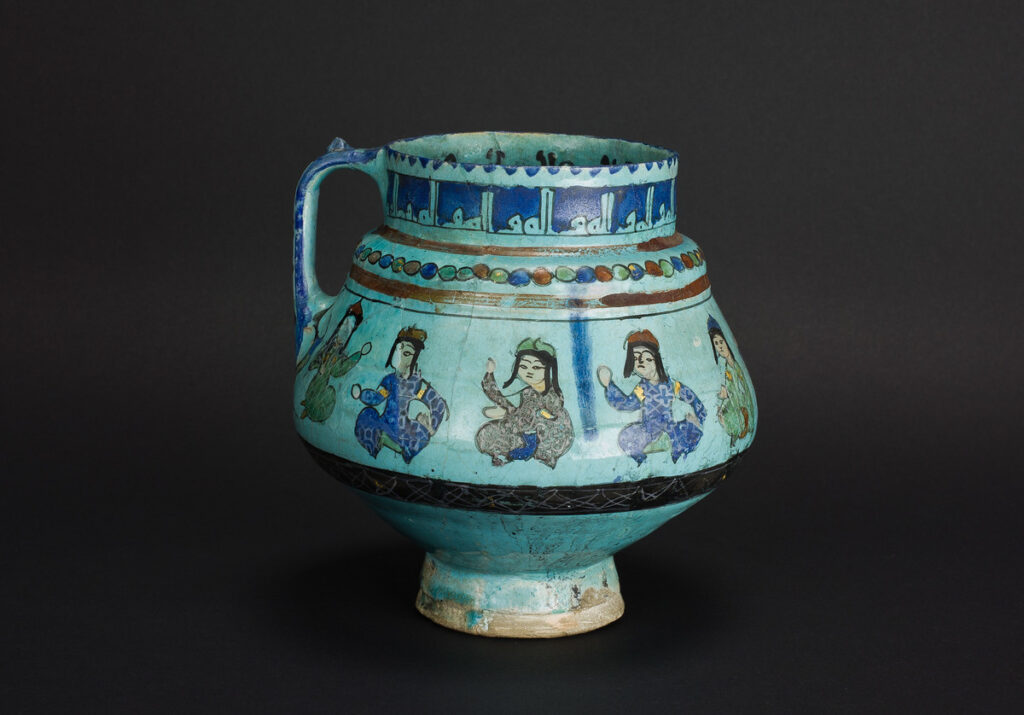
What is looking and how do we do it? For many of us we do it without thinking; we look, but we do not always know what we are looking at. This tour is meant to illuminate the difference between a passing glance and close looking, and to share minute but precious details that may easily be missed. Through this tour, visitors will discover how the smallest detail can change the way we see and understand an artwork.

Handled jug with princely figures, late 12th–early 13th century (Seljuq Period, 1037–1196), Persian, stonepaste with white glaze, overglaze enamel pigments, and gold (mina’i ware), Gift of the Arthur M. Sackler Foundation, 2012.40.15
This piece of turquoise mina’i ware is decorated with a band of ten, seated royal figures. Look closely at these men. What do you notice about their dress? Their royalty is indicated by the presence of tiraz—the gold arm bands worn on their upper arms. Tiraz were honorific embroidered bands given to courtiers and other dignitaries by the ruler. Walk around this object and look closely at the individual figures. Although almost identical, each figure is distinguished by the unique fabric of their robe, decorated variously with geometric shapes, cloud scrolls, and other patterns typical of the period. Do you see any other forms of decoration on this drinking vessel? There are two calligraphic inscriptions around the outside of the rim and on the rim’s interior. On a vessel like this, calligraphy usually offers good wishes, fortune, and luck to the owner of the object.
To read more about tiraz, click here


Faustina the Elder, second half of the 2nd century CE, Roman, marble, Purchase with the Art Acquisition Endowment Fund, Marian Hayes (Class of 1925) Art Purchase Fund, Susan and Bernard Schilling (Susan Eisenhart, Class of 1932) Fund, Warbeke Art Museum Fund, Abbie Bosworth Williams (Class of 1927) Fund, 1997.15
AND
Bartolomeo Cavaceppi (Italian, ca. 1716–1799), Bust of Faustina Minore (Faustina the Younger), ca. 1795, marble, Purchase with the Belle and Hy Baier Art Acquisition Fund and the Teri J. Edelstein Art Acquisition Fund, 2010.6
While looking at the bust of Faustina the Younger make sure to also look at the bust of her mother, to her left. What differences and similarities do you see? In ancient Rome empresses were known by their distinctive hairstyles. Fashion was inseparably tied to female identity and feminine virtues, so each hairstyle became linked to a particular empress and the qualities that she represented—like motherhood and marital harmony. The hairstyle of Faustina the Elder became popular among Roman women, who adopted it to demonstrate their admiration of Faustina and her virtues. Faustina the Younger, Faustina the Elder’s only surviving daughter, distanced herself from her mother’s legacy in Roman society by choosing her own distinct hairstyle. Try walking around the busts to note the differences. Faustina the Younger wears her hair drawn back into a low bun, while her mother has hers braided and piled up into a high, crown-like bun on top of her head.
What other differences do you notice? While the bust of Faustina the Elder is a fragment broken off at the neck, Faustina the Younger is complete, with an ornate pedestal. The color of the two busts also sets them apart; notice that Faustina the Elder looks less polished than her daughter, appearing almost dirty in comparison. In ancient Rome sculptures would have been painted to appear more lifelike, and Faustina the Elder retains some of her original pigment. Faustina the Younger, on the other hand, was made in the 18th century from unpainted white marble. The artist of Faustina the Younger’s bust attempted to recreate the style of ancient Roman sculpture, not realizing that the ancient pieces would have been brightly painted.