 GIVE
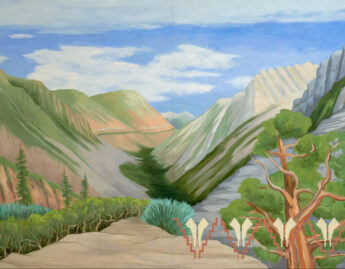
GIVEJoin us for this exciting virtual event with Cherokee artist Kay WalkingStick, who will be zooming in from her studio in Easton, PA. After a short talk, the artist will be joined by Assistant Professor of History Patricia Dawson (Cherokee Nation) for a conversation about WalkingStick’s painting Sierra Ravine (2022), recently acquired in anticipation of the Museum’s 150th anniversary.
This program is made possible by the Patricia and Edward Falkenberg Lecture Fund at the Mount Holyoke College Art Museum.
Co-sponsored with the departments of Art History, Art Studio, History, and Environmental Studies; the Miller Worley Center for the Environment; Office of Diversity, Equity, and Inclusion; Office of Community & Belonging; and the Zowie Banteah Cultural Center.
Kay WalkingStick (b. 1935 in Syracuse, NY) is a citizen of the Cherokee Nation and one of the world’s most celebrated artists of Native American ancestry. Her practice has focused on the American Landscape and its metaphorical significances to Native Americans and people across the world. She draws on formal modernist painterly traditions as well as the Native American experience to create works that connect the immediacy of the physical world with the spiritual. Attempting to unify the present with history, her complex works hold tension between representational and abstract imagery. Her paintings represent a knowledge of the earth and its sacred quality. WalkingStick earned a BFA in painting in 1959 from Beaver College of Arcadia University, Philadelphia, PA. In 1973, she was awarded a Danforth Foundation Graduate Fellowship for Women to attend Pratt Institute, Brooklyn, NY, where she earned her MFA in 1975. WalkingStick was a Professor of Fine Arts at Cornell University from 1988 until 2005. She had a major retrospective at the National Museum of the American Indian, Washington, DC, in 2015, which traveled to multiple venues across the country through 2018. The exhibition Kay WalkingStick / Hudson River School, was organized by the New York Historical Society and is currently on view at the Heard Museum in Phoenix, AZ. Her work is in many collections, including the Metropolitan Museum of Art, New York, NY; St Louis Art Museum, MO; Denver Art Museum, Denver CO; Museum of Modern Art, New York, NY; National Gallery of Art, Washington, DC; Smithsonian American Art Museum, Washington DC; Southern Plains Indian Museum, Anadarko, OK; and Whitney Museum of American Art, New York, NY.
Patricia Dawson (Cherokee Nation) teaches and researches Native American history and material culture. Dawson’s current manuscript project examines Cherokee clothing as a tool of diplomacy, symbol of identity, and weapon of resistance against Euro-American encroachment in the eighteenth and early nineteenth centuries. In the early nineteenth century, Cherokee women transformed their economy through cotton agriculture and cloth production, and they were at the center of the Nation’s resistance to Removal through material culture diplomacy. Dawson has also worked with family members to edit and publish A History of the Cherokee Nation by Rachel Caroline Eaton, Dawson’s great-great-great aunt who is believed to be the first known Native American woman to get a PhD. Originally written in the 1930s, but denied publication for being too “pro-Cherokee,” this book was released by OU Press in Fall 2025. When not teaching or researching, Dawson can often be found attempting a variety of textile projects, and she is a firm believer in fostering community through creative expression.